What a City Could Taste Like
“Modern planning segmented the city into specialized areas. The sidewalk, once a place for vending, socializing, and political activity, was declared off limits for anything but pedestrian circulation.”
By Katie Rabinowicz and Andrea Winkler
Waves of immigration in the eighteenth and nineteenth centuries brought itinerant European street vendors and their customers to North American cities. Hawkers and peddlers sold peanuts, popcorn, homemade candy, cashews, candied apples, Turkish delight, fresh fruit, and a variety of other foods. These salesmen fed the development of cities, complementing their infrastructure by taking low-cost food and goods to the new arrivals in the streets where they lived and worked.
So why, in so many cities, is there now such a dearth of street food? Essentially, it is because street food moved indoors. Modern planning segmented the city into specialized areas. The sidewalk, once a place for vending, socializing, and political activity, was declared off limits for anything but pedestrian circulation. Cooking and eating became private, indoor activities, and the sale of food became the domain of specialized retailers. At the same time, street vendors themselves became more upwardly mobile; they acculturated, bought or rented stores, and moved inside. The street lost its public culinary life.
Vendors now operate either illegally or in limited numbers in limited areas of North American cities. Strict laws covering what may be sold and where are either couched in euphemistic terms of “beautification” or “urban renewal” or explicitly target vendors, panhandlers, and street entertainers. Vending regulations that claim to work in the public interest may in practice be used against certain groups: uncoordinated or vague rules lead to ad hoc and selective enforcement. Such “street cleaning” has particularly affected women, visible minorities, and people with low incomes who rely on the sidewalks for their livelihood or cultural expression. When these groups are removed from the streets, they are cut off from their spaces of employment. Consumption and recreation become more exclusive.
Urban renewal strategies in Toronto and Washington, DC, for example, led to police crackdowns or increased restrictions on vendors. In Toronto, vendors were removed from Chinatown and Yorkville, slicing off some of the city’s space for low-income employment and consumption. In Washington, policies presented as neutral had the effect of disproportionately reducing the number of women vendors. The new regulations mandated increased licensing fees that the lower-income women could not afford, heavy carts that many women could not maneuver, and a smaller and more widely spaced vendor population that was not as safe for women vendors. In Atlanta, vending had been an important entry point into the formal economy for those facing barriers to employment, including a segment of the city’s black population. Black street vendors supplied their own communities with the goods they preferred and contributed to a local black culture and public realm. These traditions were ignored by the new vending regulations.
For some communities, illegal or informal vending is either an economic necessity or an act of rebellion against a regulatory system that is blind to the impact it has on the lives of women, minorities, and people with lower incomes. The law in many cities is indifferent to the legitimate and beneficial ends of this extralegal vending, including stronger immigrant entrepreneurialism, a more accessible public realm, a means to distribute cheap goods to poor people, and simple survival for people who may have no other way to make a living.
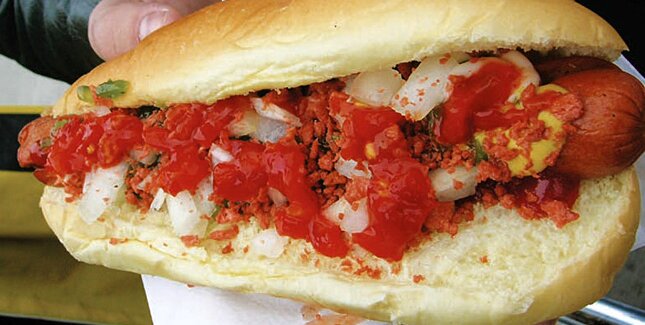
Defiant vendors are flouting the law everywhere. In Toronto, street food is theoretically limited to hotdogs (provincial health regulations limit food preparation to “the reheating of precooked meat products in the form of wieners or similar sausage products to be served on a bun”), but you can still find a summer student selling crepes outside a health food store, a Peruvian woman selling contraband empañadas in the market (she now owns an empañada restaurant), a man selling corn on the cob on a major shopping strip, and a community kitchen selling baked goods in the local park. In Oakland, California, where the Latino community established rows of illegal fruit stands and taco trucks along major thoroughfares, the city eventually legalized their informal economy as a tool for economic and cultural development.
These initiatives show what cities could taste like. Street vending could be a highly adaptable delivery system, tracking the cultural tastes of cities’ increasingly diverse populations, and bringing healthy, safe, affordable foods to appreciative customers, wherever they are. Vendors add a nimble, mobile element to a city’s food system, and can quickly adapt to changing tastes. With their low overhead costs and local roots, vendors can create and serve markets for good, locally grown and prepared food specialties.
If regulations were liberalized, vendors could sell a wider variety of foods and there would still be public health inspectors to visit carts and ensure they were clean and safe; vendors would still be trained in safe food handling. New York has a great variety of street food because the city’s rules apply to the cart, not the food. Vendors’ carts must be stored at an approved facility where they are inspected and serviced at regular intervals. Philadelphia has a similar system; when vendors apply for a food license, they specify the kind of food they propose to sell and the health department inspects their vending units accordingly.
A coordinated vending policy is needed in many cities and could be developed through meaningful public consultation with vendors, consumers, planners, and others. One of the aims of such a policy should be to support vending as viable employment for those facing barriers to employment or looking for an entry into the formal economy. Cities could provide business training, offer more vending licenses, set aside districts where informal vending would be permitted, and support vendors’ organizations.
Urban spaces could be designed specifically for vendors and their customers, for example, by providing washrooms nearby, safe spaces for women vendors, and comfortable public areas for sitting, eating, and socializing. According to Nisha Fernando, flexibility is the key: “rather than repeating the same design of sterile unused streets, leaving space for spontaneous and culture-laden street life has the potential to generate an exciting public social life in our cities. The focus must be on making urban streets flexible to their users under regulations other than those that overspecify land uses and apply strict zoning codes, so that users of different cultures can then modify, add to or change the streets in ways appropriate to their society and culture.”
With the health of urban societies, multicultural expression, and public life increasingly at issue, contemporary North American cities have an opportunity to renew one of their most vital original economies. Street food presents an opportunity to break from the usual planning practices, which often take a siloed approach to public space, focusing on zoning and narrowly defined land uses. A revival of street vending could help inform a new vision: the creation of a public realm that is supportive of cultural and employment diversity, healthy food, and tasty living.


Features from ‘Food’

Global Tastes
By John Feffer
Photo by Stanislav Stankovic
Courtiers once collected special flavors for the famous banquets of the Roman emperors “in...

What a City Could Taste Like
By Katie Rabinowicz and Andrea Winkler
Waves of immigration in the eighteenth and nineteenth centuries brought itinerant European street vendors...

Zwischenstadt 905
By Wayne Roberts
Image by Chris Thomaidis
When Roger Keil looks north from Toronto’s CN Tower, he sees more than just...

Chinese American
By Mei Chin
Translation by Lei Bo
The Chinese are considered to have one of the greatest cuisines in the world....
Food Media

The Svalbard Seed Vault
By Rebeca Duclos and David Ross
“The Svalbard vault is a silo lying on its side.”

Attempt At An Inventory
By Dean Baldwin
“It is really abject having this much food all in one grid of consumption.”

Behind The Mall
By Diana Shearwood
“So I'm driving back to the Mercier bridge and I see this egg truck and it's a good one.”
Interested in reading more Alphabet City features? Take a look at our other issues


